The Unsung Architects: Honoring the Sweat and Soul of Pakistan’s Workforce
What is World Labour Day? Observed on May 1st, it is a global day to celebrate the achievements of workers and advocate for labor rights and fair wages.
Today, as the sun rises on May 1st, 2026, the world pauses to observe International Labour Day. It is a day usually marked by public holidays and grand speeches, but beneath the surface of the ceremonial parades lies a deep, rhythmic pulse—the sound of hammers hitting steel, the whirring of textile looms, and the quiet footsteps of those who rise before dawn to keep the wheels of our civilization turning.
The Global Legacy: From Chicago to the World
World Labour Day, or May Day, is not merely a date on a calendar; it is a monument to a struggle. It commemorates the 1886 Haymarket Riot in Chicago, where workers dared to demand a simple, humane standard: the eight-hour workday. Before this movement, the concept of “work-life balance” was a luxury unknown to the masses. Men, women, and often children were tethered to machines for 12 to 16 hours a day in conditions that stripped them of their health and dignity.
The blood shed in those early movements paved the way for the rights we often take for granted today: minimum wages, safety regulations, and the right to organize. In 2026, the International Labour Organization (ILO) has centered the global conversation on a modern crisis: “Ensuring a Healthy Psychosocial Working Environment.” This theme acknowledges that in our hyper-connected, digital age, the toll on a worker is no longer just physical—it is mental.
The Pakistani Context: A Backbone of Resilience
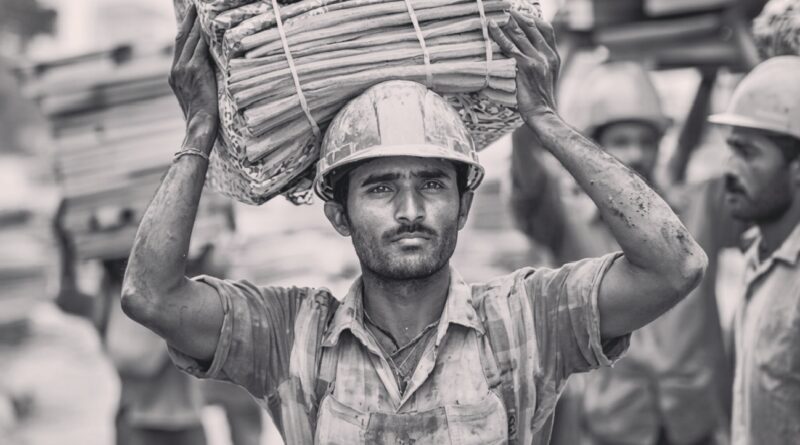
In Pakistan, Labour Day carries a specific, heavy resonance. Our nation is built on the backs of nearly 75 million workers. From the sprawling wheat fields of Punjab to the rugged coal mines of Balochistan, and from the bustling industrial hubs of Karachi to the brick kilns of Sindh, the Pakistani laborer is the silent engine of the economy.
Pakistan officially declared May 1st a public holiday in 1972, following the landmark Labour Policy that sought to provide job security and collective bargaining rights. However, as we stand in 2026, the reality for the average Pakistani worker is a complex tapestry of resilience and hardship.
The Challenges of the Informal Sector
One of the most pressing issues in Pakistan is that the vast majority of our workforce—upwards of 70%—operates in the informal sector. These are the domestic helpers, the street vendors, and the daily-wage construction workers who exist outside the net of legal protections. For them, there is no “eight-hour day,” no paid leave, and no pension.
Economic Pressure and the “Working Poor”
In recent years, global inflation and domestic economic shifts have hit the labor class hardest. While the minimum wage has seen periodic increases—currently hovering around PKR 35,000 to PKR 37,000 depending on the province—the skyrocketing cost of utilities and food means that many are now classified as the “working poor.” A job is no longer a guaranteed escape from poverty; for many, it is a desperate race just to stay level with the rising tide of expenses.
A New Frontier: The Digital and Green Transition
As we look toward the future, the Pakistani worker faces new, unprecedented shifts:
- The Rise of AI and Automation: As highlighted in recent discourse, even traditional roles in textiles and data processing are being challenged by technology. The struggle today is not just for fair pay, but for re-skilling—ensuring that our workforce isn’t left behind as the world moves toward an automated economy.
- Climate Change and Workplace Safety: Pakistan remains one of the most climate-vulnerable nations. For outdoor laborers, extreme heatwaves have turned “standard” working conditions into life-threatening environments. The demand for “Green Jobs” and climate-resilient workplace safety is no longer a choice; it is a necessity for survival.
Progress on the Horizon
It is not all bleak. There are signs of a shifting tide. The introduction of the Punjab Labour Card and similar digital initiatives in other provinces represent a move toward formalizing the informal. By digitizing worker records, the state is finally beginning to bridge the gap between a worker and their rights—granting access to social security, healthcare, and education for their children.
Furthermore, the legal recognition of agricultural and domestic workers in various provincial legislations over the last few years marks a historic shift. For the first time in our history, the woman picking cotton in a field or the man cleaning a home is being legally acknowledged as a “worker” entitled to the dignity of the law.
The Call to Action
Labour Day should not be the only day we think about the people who build our homes and grow our food. True celebration lies in systemic empathy. It requires:
- Fair Wages: Ensuring that the minimum wage is not just a suggestion, but a livable reality.
- Safety Standards: Moving beyond “paper policies” to actual inspections in factories and mines.
- Dignity of Labour: Cultivating a culture where every job—from the sanitation worker to the software engineer—is treated with equal respect.
Conclusion: The Hands That Shape Tomorrow
The history of Pakistan is written in the calloused hands of its workers. As we celebrate World Labour Day 2026, let us remember that an economy is not measured by its GDP alone, but by the well-being of the people who create that wealth.
To the laborers of Pakistan: your sweat is the ink of our progress, and your resilience is the backbone of our hope. Today, we don’t just give you a holiday; we give you our gratitude and a renewed promise to fight for the dignity you have so rightfully earned.
“Work is not just a duty, it is dignity. Success is built on the strength of hardworking people; celebrate the hands that build the world.”