
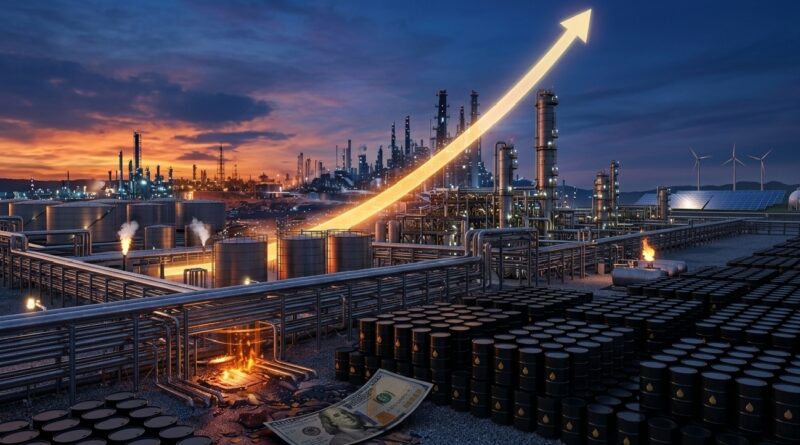
The Petro-Paradox: Global Energy and the US-Iran Brinkmanship
The global oil market has entered a period of extraordinary upheaval. After hitting a peak of $115 per barrel in the second quarter of 2026, the energy landscape is being reshaped by a collision between historic geopolitical ruptures and a desperate global pivot toward energy security.
As we navigate the remainder of 2026 and look toward 2027, the world is facing a “Straitjacket Market”—where supply is technically growing, yet the fear of a total shutdown in the Middle East keeps prices at agonizing highs.
1. The Tinderbox: US-Iran Escalation and the $120 Barrier
The primary driver of current volatility is the direct military friction between Washington and Tehran. Following the closure of the Strait of Hormuz on March 4, 2026, oil and LNG exports were effectively stranded, causing Brent Crude to surge past $120.
- The Shadow War: Ongoing maritimeconflict has added a permanent “war premium” of roughly $24/b to global prices.
- Supply Shocks: The International Energy Agency (IEA) has characterized this as the “largest supply disruption in history,” with nearly 20 million barrels per day (bpd) of crude and one-fifth of global LNG at risk.
- The Global Response: In a historic move, IEA member countries released 400 million barrels from emergency reserves in March to prevent a total economic freeze, yet prices remain sticky due to the risk of a “hot” conflict.
2. The Fragmentation of Energy Power
While the US-Iran conflict tightens the market, the internal politics of oil production are fracturing. The United Arab Emirates (UAE) recently distanced itself from OPEC+ production quotas to pursue its own capacity goal of 5 million bpd by 2027.This “Every Nation for Itself” strategy creates a bizarre market dynamic; a potential long-term surplus is being masked by immediate short-term scarcity.
3. The Future: A Fragile Global Economy
The 2026 energy crisis has echoed the stagflation of the 1970s. High energy costs are acting as a “tax” on global growth, with the OECD warning that global GDP could slow from 2.9% to 2.5% if prices stay elevated into 2027.
- Demand Destruction: Developing economies are feeling the brunt, with growth forecasts downgraded as high fuel costs erode consumer spending.
- The AI Energy Crunch: Paradoxically, while oil demand faces “destruction” in transport, global power demand is surging by 3.7%—twice the rate of total energy growth—driven by the massive expansion of AI data centers.
| Sector | Current Trend (2026) | Future Outlook (2030) |
| Oil Prices | $115–$120/b (Peak) | $70–$75/b (Equilibrium) |
| Electrification | Renewables meeting 25% of demand | Electricity growing 2.5x faster than total energy |
| Battery Tech | $100/kWh milestone reached | $70/kWh (ICE cost parity) |
Energy Security Focus on Strategic Reserves Transition to Nuclear/Green Hydrogen
The Bottom Line
The road to 2027 is a tug-of-war. On one side, the US-Iran standoff threatens to push the world into a recessionary spiral. On the other, the rapid scaling of renewables, nuclear, and battery technology offers an escape hatch from fossil fuel volatility.
For the global economy, the “next” phase isn’t just about finding more oil—it’s about surviving the current price shock long enough for the new energy infrastructure to take the wheel. Until the Strait of Hormuz is fully secured and the “war premium” fades, the global economy will remain on a knife’s edge.