
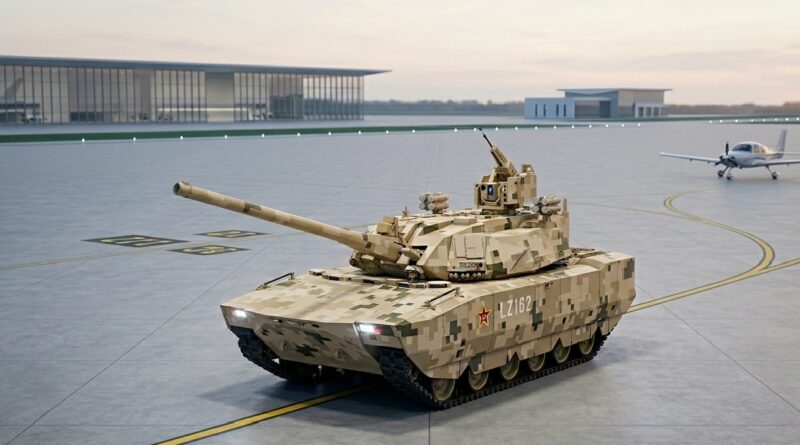
The Shape of Next-Gen Warfare: Inside China’s Type 100 Main Battle Tank
For decades, military analysts have watched China’s armored forces evolve through iterative updates of Soviet-era design philosophies. The Type 59 medium tank gave way to the Type 96, which eventually led to the formidable Type 99 main battle tank. However, a total paradigm shift has officially arrived on the modern battlefield.
In a highly publicized move timed with Youth Day on May 3, 2026, China’s newest main battle tank, the Type 100 (also designated as the ZTZ-100), was observed for the first time in active combat exercises with regular army units. Deposition patterns and terrain markers indicate the vehicles were deployed in northern China.
Moving away from the ceremonial optics of its debut at the 70th anniversary of Victory parade, this deliberate demonstration in a simulated combat environment signals that mass deliveries to the military have officially begun.
Low Profile, High Protection: Visual Appearance
The visual silhouette of the Type 100 is striking and represents a radical departure from traditional armored vehicle aesthetics. By moving the entire crew into the hull, the vehicle achieves an incredibly low-profile, sleek exterior.
• The Unmanned Turret
The most visually defining characteristic is the completely flat, low-slung unmanned turret. It features a stark, angular design optimized for radar cross-section reduction and modular armor attachment. The turret roof is entirely slick, noticeably devoid of standard crew hatches, vision blocks, or machine gun rings. Instead, its surface is broken only by subtle, flush service apertures, automated optical sensor pods, and a compact active protection system (APS).
• The Frontal Citadel
At the front of the hull, the side-by-side hatches for the commander and driver sit practically flush with the sharply sloped glacis plate. This design gives the front of the tank a clean, wedge-like appearance, concentrating the vehicle’s thickest composite protection around the crew capsule. Depending on the configuration of its modular armor panels, the tank maintains an agile weight of 35 to 40 tons, presenting a far more compact target than its 60-plus ton Western counterparts.
Captured in Action: The Recent Combat Exercises
The latest footage released from the May 2026 exercises offers a rare, dynamic look at how the Type 100 operates outside of pristine exhibition halls. Deployed across the rugged, arid terrain of northern China, the tanks were filmed kicking up plumes of dust while executing high-speed maneuvers alongside regular mechanized infantry units.
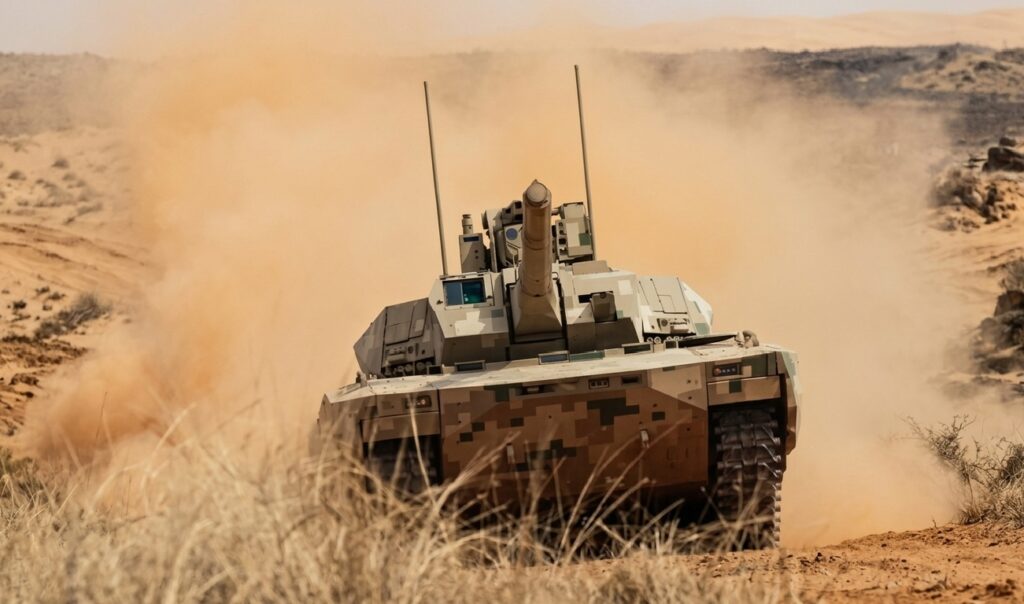
In these exercises, the ZTZ-100 demonstrated its low-profile advantages in a simulated combat environment, utilizing natural ridge lines for hull-down positioning where only its flat, unmanned turret was exposed to opposition forces. Observers noted that the tank’s active protection systems and automated optical tracking pods were fully operational during the drills, actively scanning the simulated battlespace while the vehicle fired on the move. This unscripted environment heavily suggests that the military is actively training crews to rely on the vehicle’s automated and AI-driven systems under high-stress conditions.
Autonomous Functions: The Two-Crew Concept
The reduction of the onboard crew to just two personnel is made possible by an unprecedented level of internal automation. The traditional role of the gunner has been entirely deleted, with those functions transferred directly to automated subsystems.
The tank’s Fire Control System (FCS) and Combat Information and Control System (CICS) are deeply integrated with elements of artificial intelligence. The AI doesn’t just calculate ballistic trajectories; it carries out target tracking, prioritizes threats, and executes specific tactical tasks autonomously.
Furthermore, the ZTZ-100 operates as a highly digitized network node. Its onboard systems link it dynamically to higher-level command networks, allowing the two-man crew to coordinate multi-domain unit operations and perform advanced command-and-control functions right from the front lines.
Modular Armament Capabilities
To ensure versatility across different combat theaters, Chinese engineers built the Type 100 around a highly unique modular weapon architecture. The tank can be reconfigured before deployment into two distinct baseline variants, each paired with its own specialized autoloader:
- The ‘Heavy’ Configuration: Designed for high-intensity, peer-to-peer kinetic conflicts, this layout equips the tank with a heavy-hitting 125 mm smoothbore gun or a highly accurate 105 mm rifled gun to punch through enemy main battle tanks and reinforced fortifications.
- The ‘Light’ Configuration: Optimized for rapid deployment, urban warfare, and low-intensity operations, this layout downscales the primary weapon to a 90 mm or 76 mm gun. This reduces the vehicle’s logistical footprint and allows it to carry specialized utility munitions for restrictive environments like mountains or marshlands.
Strategic Implications
The operational emergence of the ZTZ-100 indicates that China has successfully bypassed the steep technical hurdles that usually plague next-generation tank development—most notably, maintaining full situational awareness for a crew restricted entirely to the hull. By fielding a lightweight, AI-driven, modular armor platform, the Chinese military is transitioning toward a highly fluid, networked style of armored warfare, fundamentally reshaping armored doctrine for the modern era.


![US President Donald Trump speaks during a news conference at the White House in Washington, DC, on April 25, 2026 [Tom Brenne/AP], Photo via: Al Jazeera](https://pkfeed.info/wp-content/uploads/2026/04/1777185376252-390x205.jpg)