
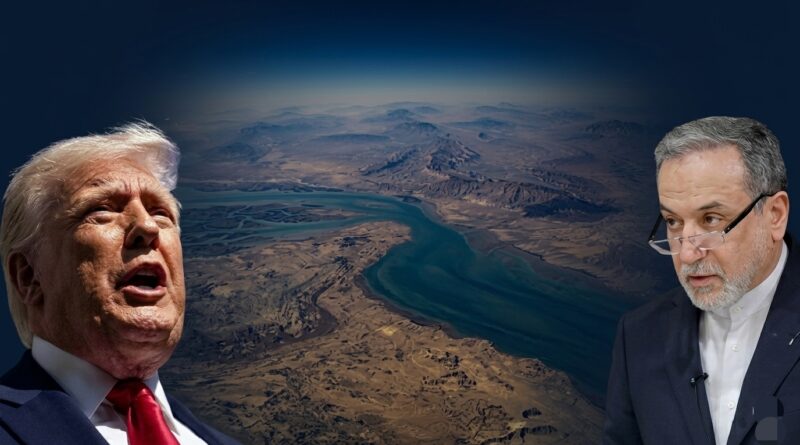
The Hormuz Standoff: Trump Claims Iran “Collapse” as Global Oil Markets Teeter on the Brink
WASHINGTON/ISLAMABAD — The geopolitical landscape shifted violently on Tuesday as U.S. President Donald Trump claimed that Tehran is in a “state of collapse.” In a characteristic post on Truth Social, the President asserted that Iran has reached out to the United States with an urgent plea to reopen the Strait of Hormuz—the world’s most vital energy artery—as the Islamic Republic grapples with a leadership crisis following months of devastating conflict.
”Iran has just informed us that they are in a State of Collapse,” Trump posted. “They want us to Open the Hormuz Strait, as soon as possible, as they try to figure out their leadership situation (Which I believe they will be able to do!).”
This development comes at a moment of extreme volatility. While Trump suggests a regime on the brink, diplomatic cables from Islamabad and Doha paint a more complex picture of a region desperate to avoid a total economic and humanitarian meltdown.
The Mediation Effort: Pakistan in the Crosshairs
With the U.S. and Iran at a direct military and diplomatic impasse, Pakistan has emerged as the central mediator. Qatar, a long-time regional bridge, has thrown its full weight behind Islamabad’s efforts.
Dr. Majed Mohammed al-Ansari, Qatar’s Foreign Ministry spokesperson, emphasized that Doha is in “full solidarity” with Pakistan. “We do not need to expand the circle of negotiations. We support Pakistani mediation,” al-Ansari stated, urging that the Strait of Hormuz be reopened “immediately regardless of other considerations.”
However, the “shuttle diplomacy” led by Iranian Foreign Minister Abbas Araghchi—who visited Islamabad twice last weekend before flying to Russia—hit a major snag. President Trump abruptly canceled a planned visit by his special envoy, Steve Witkoff, and son-in-law, Jared Kushner, to the Pakistani capital, dismissing the trip as a “waste of time.”
A Conflict Born of “Red Lines”
The current war, which began with U.S.-Israeli strikes on Iranian military and civilian centers, has left a trail of deep scars. Most notable is the strike on an Iranian school that killed approximately 168 schoolchildren, an event that has fueled domestic and international outrage.
The diplomatic friction remains rooted in the ghost of the 2015 Nuclear Deal (JCPOA). While Iran maintains its nuclear program is for peaceful purposes, Trump’s unilateral withdrawal during his first term and the subsequent “Maximum Pressure” campaign have destroyed the foundations of trust.
Currently, the two sides remain deadlocked over fundamental issues. Iran is demanding that the Strait of Hormuz be reopened under its own oversight and that the U.S. naval blockade end before nuclear discussions even begin.
Conversely, the Trump administration has set firm “red lines” on regional security and insists on a comprehensive deal that addresses enrichment and military activity simultaneously.
Economic Fallout: The Global Toll
The “physical flow” of oil is now the only metric that matters to global markets. Before the conflict, roughly 140 ships crossed the Strait daily; yesterday, that number dwindled to just seven.Ghost Tankers: At least six tankers loaded with Iranian crude were recently forced back by a U.S. naval blockade.
- Price Surge: Oil prices have resumed an upward march as traders realize the “dual blockade”—the U.S. blockading Iranian ports and Iran restricting the Strait—shows no sign of easing.
- Piracy Accusations: Tehran has condemned U.S. seizures of its tankers as “outright legalization of piracy and armed robbery on the high seas.”
The Path Forward: Decoupling or Deadlock?
Senior Iranian officials indicate that Araghchi’s proposal in Islamabad was to “decouple” the issues: resolve the war and the maritime blockade first, providing guarantees that the U.S. cannot restart hostilities, and save the thorny nuclear enrichment dispute for a later stage.
The White House, however, remains skeptical. With falling approval ratings and a public weary of shifting rationales for the war, Trump is balancing his “Maximum Pressure” instincts against a domestic demand for an exit strategy.As the U.S. refuses to “negotiate through the press,” the world waits to see if Trump’s claim of an Iranian “collapse” is a precursor to a breakthrough or the prelude to a final, more dangerous escalation.