
Beyond the Water Bottle: Why Hydration Alone Isn’t the Cure for Kidney Stones
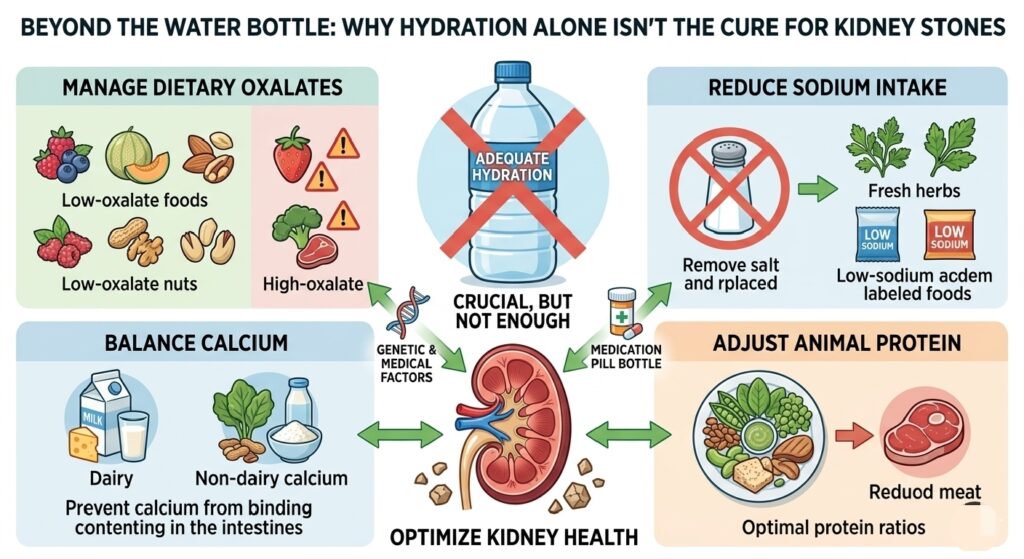
Anyone who has experienced the agonizing, white-knuckle pain of a kidney stone knows the desperation that follows. It is a pain so profound that it frequently leads to immediate, radical lifestyle changes. When these patients seek medical advice, they are almost universally met with a singular, simple command: “Drink more water.”
On paper, the logic is flawless. Kidney stones are essentially crystals formed from minerals like calcium, oxalate, and uric acid. By increasing fluid intake, you dilute the urine, making it harder for these minerals to bond together and grow into stones. However, a groundbreaking new study involving over 1,600 participants suggests that this “common sense” advice might be oversimplified and, for many, practically unsustainable.
The PUSH Study: A Reality Check for Hydration
Researchers recently conducted one of the largest and most rigorous trials of its kind, known as the Prevention of Urinary Stones with Hydration (PUSH) study. They followed over 1,600 adolescents and adults across multiple U.S. medical centers who had a history of kidney stones.
To test whether extreme hydration could actually stop the cycle of recurrence, they split participants into two groups:Standard Care Group: Given the typical advice to stay hydrated.
Structured Intervention Group; This group received an arsenal of modern tools, including smart water bottles that tracked every sip, personalized fluid targets, text message reminders, health coaching, and even financial incentives.The goal for the intervention group was ambitious, maintain a urine output of at least 2.5 liters per day. This level is widely considered the “gold standard” for keeping stone-forming minerals at bay.
The Findings: More Water, Same Stones
The study lasted two years, and the results were a wake-up call for the urological community. While the intervention group did succeed in drinking more water and increasing their urine output compared to the control group, the actual clinical outcome was stagnant.
The rate of kidney stone recurrence was nearly identical across both groups.Despite the smart bottles and the coaching, the increased hydration did not statistically reduce the risk of a new stone forming. This leads to a critical question: If one in 11 Americans will have a kidney stone, and nearly half of those will suffer a recurrence, why isn’t the simplest solution working?
The Sustainability Gap
The primary takeaway from the PUSH study isn’t that water is useless—it’s that consistent, high-volume hydration is incredibly difficult to maintain. Even with financial rewards and high-tech reminders, life gets in the way.
Participants found it challenging to hit the 2.5-liter mark every single day for two years. People get busy, they travel, they forget their smart bottles, or they simply grow tired of the constant trips to the bathroom. In the real world, the “simple” advice of drinking more water often collapses under the weight of human habit and logistics. If the threshold for prevention is that high, relying on fluid volume alone may not be a sustainable long-term strategy for the average person.
The Missing Piece: Electrolytes and Urine Chemistry
If volume isn’t the whole story, what is? Emerging evidence suggests we need to look closer at electrolytes and the chemical balance of the fluid we are drinking.
Hydration isn’t just about the quantity of water entering the body; it’s about how the kidneys manage that fluid and the minerals dissolved within it. Electrolytes—specifically sodium, potassium, and magnesium—play a vital role in this process.
- Sodium: High salt intake is a notorious driver of kidney stones because it forces the kidneys to excrete more calcium into the urine.
- Potassium and Magnesium: These minerals act as “inhibitors.” Potassium, often found in citrate form, helps raise the pH of urine, making it less acidic and less hospitable to stone formation. Magnesium can bind to oxalate in the digestive tract, preventing it from ever reaching the kidneys.
When we focus solely on “dilution” through water, we ignore the “concentration” of the substances being diluted. A person drinking three liters of water a day but consuming a high-sodium diet may still be at a higher risk than someone drinking two liters of water with a balanced mineral profile.
A Multidimensional Approach to Prevention
The PUSH study forces us to move toward a more nuanced view of kidney health. Prevention is not a single-step process; it is a combination of volume, chemistry, and lifestyle.
1. Diet Matters as Much as Water
For many stone-formers, reducing sodium and animal protein while increasing intake of calcium-rich foods (to bind oxalate in the gut) is more effective than simply doubling water intake.
2. Quality over Quantity
Focusing on fluids that provide stone-inhibiting citrates—like lemon water or specific electrolyte-balanced drinks—may offer more protection than plain tap water alone.
3. Understanding Your Specific Stone
Not all kidney stones are the same. A 24-hour urine collection test can tell a patient exactly what minerals are out of balance. For some, the problem is too much calcium; for others, it’s too little citrate. Targeted treatment beats “blanket” hydration every time.
Conclusion
The pain of a kidney stone is a powerful motivator, but motivation alone isn’t enough to overcome a biology that demands constant, perfect hydration. The recent research highlights a hard truth: we cannot simply “water away” the problem of kidney stones. While staying hydrated remains a cornerstone of kidney health, it is time to stop viewing it as a panacea. Real prevention requires a sustainable balance of fluid intake, dietary adjustments, and an understanding of the electrolytes that keep our internal chemistry in check. If you want to avoid another stone, don’t just reach for the water bottle—look at the whole picture.