
Brinkmanship in Islamabad: The High-Stakes Gamble to Avert a Wider War
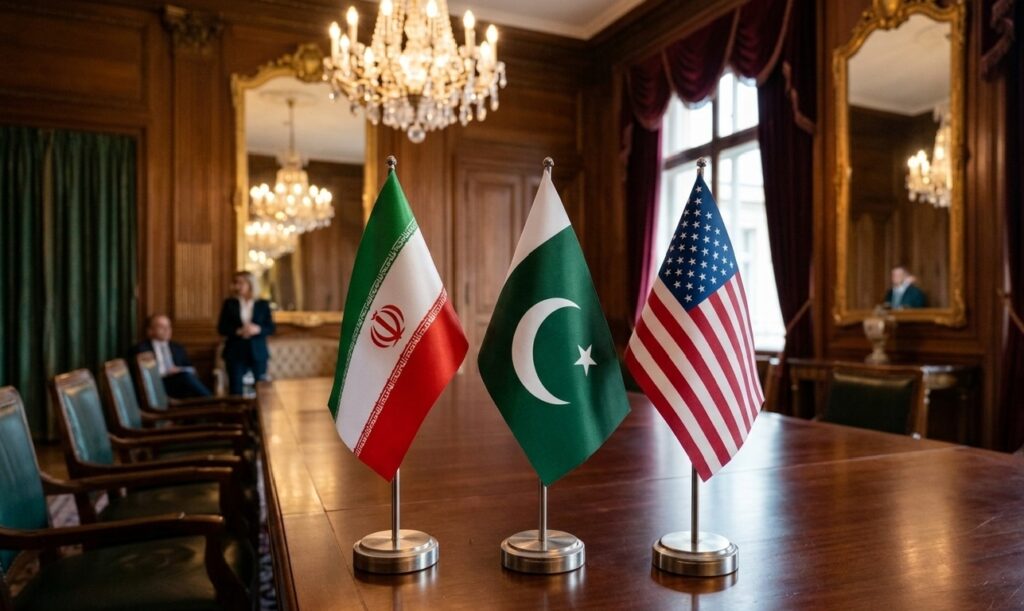
ISLAMABAD — The eyes of the world are fixed on the fortified “Red Zone” of Pakistan’s capital, where a masterclass in diplomatic brinkmanship is unfolding. With less than 48 hours remaining before a fragile ceasefire expires, the prospects for a second round of peace talks between the United States and Iran are teetering on the edge of collapse.
What was intended to be a multi-day summit to secure a long-term Memorandum of Understanding (MoU) has instead turned into a tense standoff, marked by naval seizures, social media threats, and a deepening chasm between public rhetoric and private diplomacy.
A Truce Under Fire
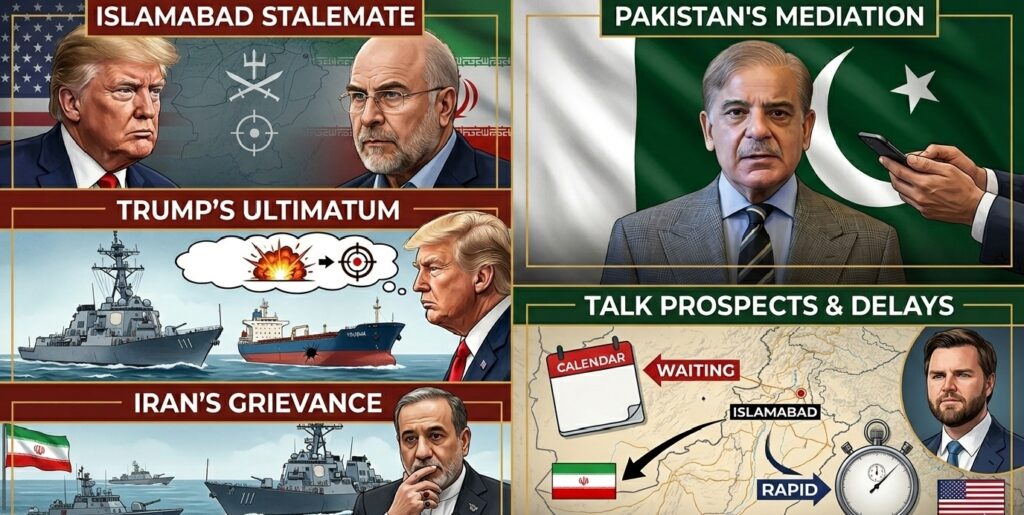
The atmosphere soured rapidly on Monday when Iranian Foreign Ministry spokesman Esmaeil Baghaei announced that Tehran has “no plans” to send negotiators to Islamabad. Iran’s grievance is rooted in what it calls a “criminal” US naval blockade of the Strait of Hormuz, which began on April 13.
Tensions reached a boiling point following the overnight capture of the Iranian container ship Touska by the US military. While President Donald Trump characterized the interception as a necessary move against a sanctioned vessel—stating the US Navy “blew a hole in the engine room” to stop it—Tehran has denounced the act as “piracy” and a blatant violation of the ceasefire.
”No More Mr. Nice Guy”
True to his signature style, President Trump has coupled the diplomatic outreach with heavy-handed warnings. While confirming that a high-level delegation including Jared Kushner and Special Envoy Steve Witkoff is bound for Pakistan, Trump took to Truth Social to issue a scorched-earth ultimatum.
“We’re offering a very fair and reasonable DEAL… if they don’t [take it], the United States is going to knock out every single Power Plant, and every single Bridge, in Iran. NO MORE MR. NICE GUY!”
Despite these threats, the US delegation remains prepared to engage, though the arrival of Vice President JD Vance remains uncertain due to evolving security concerns.
Despite these threats, the US delegation remains prepared to engage, though the arrival of Vice President JD Vance remains uncertain due to evolving security concerns.
Pakistan: The Reluctant Host at the Center of the Storm
For Pakistan, the stakes could not be higher. Prime Minister Shehbaz Sharif has spent the last week engaged in a whirlwind of “shuttle diplomacy,” consulting with leaders in Saudi Arabia, Qatar, and Turkiye to build a regional consensus.
In Islamabad, the preparations are visible and somber:
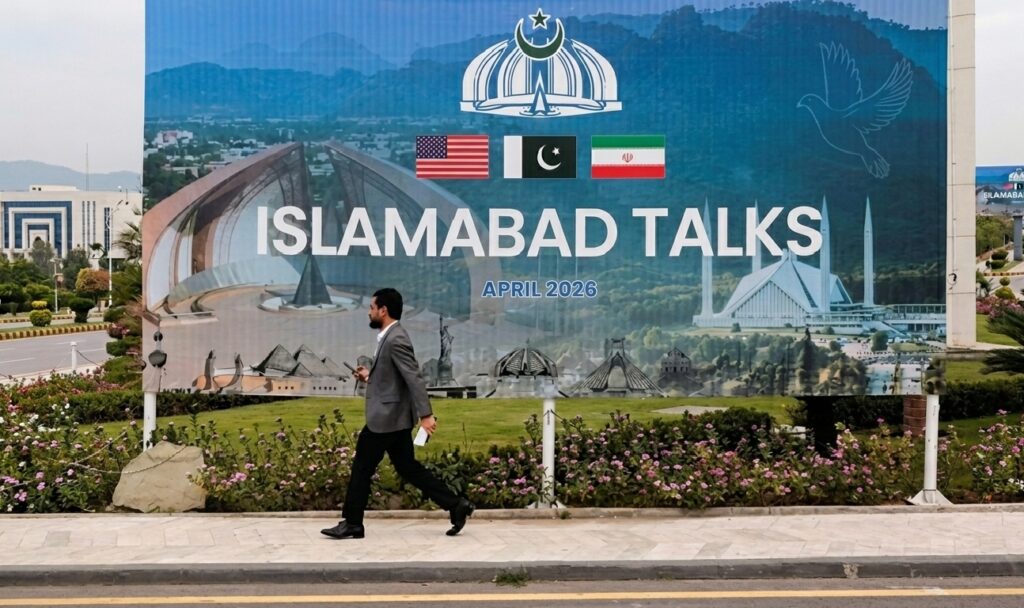
- The Serena and Marriott Hotels have been cleared of regular guests to house the delegations.
- The Red Zone is under a complete security lockdown, lined with barbed wire and thousands of paramilitary troops.
The Strategy of Shadows
Analysts suggest that Iran’s public refusal to attend might be a tactical maneuver rather than a final “no.” Historically, Tehran utilizes a “dual-track” strategy; maintaining a hardline public stance to appease domestic audiences while keeping private diplomatic channels open to test the waters.
As one diplomat in Islamabad noted, the fundamental difference lies in the perception of time: “The Americans brought a stopwatch, whereas the Iranians came with a calendar.”
What’s at Stake?
If the talks proceed, the immediate goal is modest but vital; a 60-day ceasefire extension. A formal MoU would provide the “breathing room” necessary to tackle the core, seemingly intractable issues:
- The Nuclear Program: Iran’s “10-point proposal” vs. Washington’s “maximalist” demands.
- Maritime Sovereignty: Control and freedom of navigation in the Strait of Hormuz.
- Regional Proxies: The durability of the Israel-Lebanon truce and its impact on Tehran’s regional interests.
As the clock ticks toward Wednesday’s deadline, Islamabad remains a city of barricades and hushed conversations. Whether the “stopwatch” or the “calendar” prevails will determine if the region moves toward a hard-won peace or descends back into a devastating conflict.
![US President Donald Trump speaks during a news conference at the White House in Washington, DC, on April 25, 2026 [Tom Brenne/AP], Photo via: Al Jazeera](https://pkfeed.info/wp-content/uploads/2026/04/1777185376252-390x205.jpg)